CPPE says Nigeria retail trade faces growing foreign competition
CPPE warns growing foreign participation in Nigeria's retail sector could pressure domestic MSMEs and threaten millions of jobs.
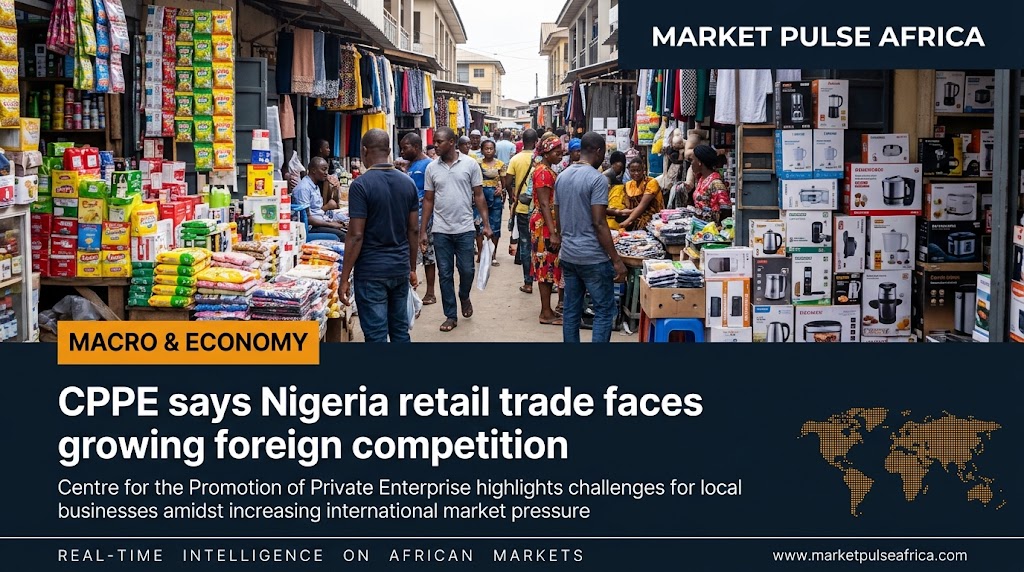
CPPE Says Nigeria Retail Trade Faces Growing Foreign Competition
The Centre for the Promotion of Private Enterprise (CPPE) has raised concerns over the growing participation of foreign nationals, particularly Chinese traders, in Nigeria's retail and distributive trade sector — warning that the trend could intensify competitive pressure on Nigerian-owned businesses already struggling with weak consumer demand, high financing costs and rising operating expenses.
What CPPE Said
The concerns were laid out in a policy brief issued Sunday by CPPE Chief Executive Officer Dr. Muda Yusuf, who said the increasing presence of foreign traders is affecting sectors including textiles and fabrics, ICT products and phone accessories, automobile spare parts and tyres, electrical products, plumbing materials, and household goods. "The increasing penetration of foreign traders into the retail segment therefore deserves urgent policy attention," Yusuf said.
Yusuf pointed to the scale of what's at stake: Nigeria's distributive trade sector employs an estimated 27.5% of the country's workforce, making it a major source of employment and livelihood, particularly for micro, small and medium-sized enterprises (MSMEs). He argued that retail trading is generally not a specialised activity requiring scarce foreign expertise, which raises questions about the effectiveness of Nigeria's current regulatory and immigration framework in governing who participates in the sector.
What's Driving the Concern
According to CPPE, the specific issue isn't foreign investment or Nigeria's broader trade relationship with China — the country remains one of Nigeria's largest trading partners and a major source of imports spanning machinery, industrial inputs, consumer goods and technology products. Rather, the concern centers on foreign manufacturers and suppliers moving further down the distribution chain into direct retail competition. The brief described a scenario in which "overseas manufacturers or major suppliers sell products to Nigerian importers and distributors, and subsequently establish operations that compete directly with those same businesses at the retail end of the market," which CPPE said creates legitimate concerns about market structure and fair competition.
The policy brief followed a protest by auto spare parts traders at the Lagos International Trade Fair Complex along the Lagos-Badagry Expressway against the alleged expansion of Chinese merchants into retail trading within the market. CPPE said complaints from traders have emerged across several product categories, and that protests in major commercial markets warrant government attention.
CPPE's Policy Recommendations
Yusuf called for several specific measures: stronger enforcement of existing investment and immigration rules, formal investigation of complaints raised by Nigerian traders, clearer guidelines defining the scope of foreign participation across the distributive trade value chain, and better coordination among immigration, investment, trade and labour authorities. He emphasized that foreign participation should be aligned with demonstrable skills gaps and specialised competencies — rather than occurring in retail segments where Nigerian businesses already possess substantial domestic capacity.
CPPE was careful to frame its position as balanced rather than protectionist, stating that Nigeria needs foreign investment but also needs to protect the entrepreneurial space that sustains millions of domestic businesses and livelihoods.
Historical and Economic Context
Nigeria's distributive trade sector has long served as a critical employment absorber, particularly for the country's vast MSME population, given the sector's low barriers to entry relative to more capital-intensive industries. China's economic footprint in Nigeria has grown substantially over the past two decades, evolving from a primarily upstream trade relationship — Chinese manufacturers supplying Nigerian importers and distributors — toward a more complex presence that now, according to CPPE, increasingly extends into direct retail operations in some markets.
This tension mirrors debates seen in other African markets over the years, where the scale and organisation of Chinese-linked retail and wholesale operations has periodically drawn scrutiny from domestic trader associations and policymakers concerned about market structure and local business displacement.
Why It Matters for Africa
CPPE's warning carries implications that extend beyond the specific sectors named in the brief:
Employment and livelihoods. With distributive trade accounting for an estimated 27.5% of Nigeria's workforce, increased competitive pressure in this sector has outsized implications for household income and informal-sector employment relative to more capital-intensive industries.
Investment climate signals. How Nigeria responds — whether through tighter permit enforcement or a more open stance — will send a signal to foreign investors about the predictability and scope of market access rules, a factor that matters for broader foreign direct investment decisions across sectors.
Regional trade and China-Africa relations. As several African economies grapple with similar questions about the scope of Chinese economic participation, particularly at the retail level, Nigeria's policy response could serve as a reference point for other markets navigating comparable pressures.
MSME sector resilience. Given that Nigerian businesses in the flagged sectors already face weak consumer demand and high financing costs, any additional competitive pressure compounds existing structural challenges facing the country's small business ecosystem.
Key Figures at a Glance
Metric | Figure |
|---|---|
Share of Nigerian workforce in distributive trade | ~27.5% |
Sectors flagged | Textiles, ICT/phone accessories, auto spare parts, tyres, electrical products, plumbing materials, household goods |
Trigger event | Trader protest at Lagos International Trade Fair Complex |
Policy brief date | September 20, 2026 (Sunday) |
What Businesses and Investors Should Watch
Government response to CPPE's call for stronger enforcement of investment and immigration regulations, including any formal policy review.
Further trader protests or complaints emerging in other Nigerian commercial markets beyond Lagos.
Any clarification from regulatory authorities on permit and business classification rules governing foreign participation in retail trade.
Broader China-Nigeria trade relationship developments, given CPPE's explicit effort to separate its retail-specific concerns from the wider bilateral trade relationship.
Key Takeaways
For Businesses
Nigerian MSMEs in the flagged sectors should monitor regulatory developments closely, as policy responses could affect competitive dynamics in the near term.
Foreign investors and traders operating in Nigeria's retail space should stay attentive to potential changes in permit enforcement or classification guidelines.
For Investors
Track how Nigeria balances foreign investment openness against domestic business protection, as a signal of broader regulatory predictability.
Watch for policy announcements from trade, investment and immigration authorities in response to CPPE's recommendations.
For General Readers
Understand that the concern raised is specific to retail-level competition, not a broader stance against foreign investment or China-Nigeria trade.
Follow how employment-heavy sectors like distributive trade factor into Nigeria's broader economic policy debates.
How MarketPulse Africa Helps
For readers tracking Nigeria's trade and investment policy landscape, MarketPulse Africa's Macro & Economy coverage brings together business sector developments, regulatory policy shifts, and trade relationship dynamics shaping the country's economic environment. MarketPulse Africa will continue tracking how this debate over foreign participation in Nigeria's retail sector develops.
Conclusion
CPPE's warning over growing foreign participation in Nigeria's retail trade highlights a genuine tension between welcoming foreign investment and protecting the employment-heavy distributive trade sector that sustains millions of Nigerian livelihoods. With trader protests already surfacing in major commercial markets, how Nigerian authorities respond to CPPE's call for clearer permit guidelines and stronger enforcement will likely shape the competitive landscape for domestic retailers in the months ahead. Follow MarketPulse Africa for continued coverage and real-time intelligence on African markets.