Kano cuts 2026 budget by N276 billion, cites FAAC revenue shortfall
Kano State has cut its 2026 budget by about N276 billion after FAAC receipts fell short. Here is what the numbers show, what happens to capital projects, and what to check in the revised budget.
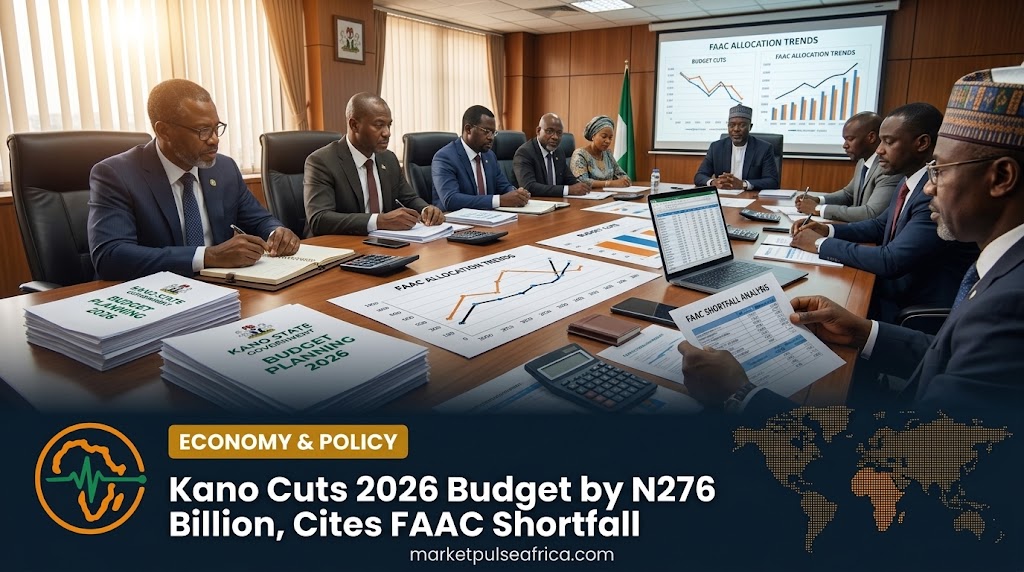
The Kano State House of Assembly has approved a cut of about N276 billion to the state's 2026 budget, citing a shortfall in revenue from the Federation Account Allocation Committee (FAAC). The original plan of N1.478 trillion depended on about N909.94 billion from FAAC, roughly 62 percent of planned spending. In the first half of 2026, Kano received N152.57 billion, about 16.8 percent of that projection. Capital spending, which had been planned at more than N1 trillion, is being reduced. The cut shows how exposed state governments remain to federal revenue, and what happens to infrastructure plans when that revenue falls short. This article sets out the numbers, what they mean for projects, and what to check in the approved budget.
Contents
- The cut and the numbers behind it
- The FAAC shortfall
- What happens to capital spending
- Why states depend on FAAC
- What to check in the revised budget
The cut and the numbers behind it
According to Nairametrics, the original 2026 budget was approved at N1.478 trillion. The Assembly has now reduced it by about N276 billion, which would bring it to roughly N1.21 trillion. The original plan drew on several sources. It projected N909.94 billion from FAAC, N138.44 billion from internally generated revenue, N186.77 billion from grants and N140.42 billion from the capital development fund.
One figure needs checking. The reported budget falls from N1.478 trillion to N1.21 trillion, a difference of about N268 billion, not N276 billion. The gap may reflect rounding, a revision to the base figure or a different approved total. The Assembly's final figure should be confirmed before the number is quoted as settled.
The FAAC shortfall
FAAC is the federal body that shares the revenue pool from oil, taxes and other sources among the federal government, the states and local governments. Its monthly disbursements determine how much money states can spend, and they are often the largest part of a state's budget.
Kano's first-half receipts were N152.57 billion, compared with N120.04 billion in the same period of 2025. That is a year-on-year increase, but it falls far short of the full-year projection. If receipts continued at the first-half pace, Kano would collect about N305 billion from FAAC for the year, well below the N909.94 billion planned. The shortfall is the core reason for the cut.
What happens to capital spending
The cut falls heavily on capital projects. Reports indicate the state had earmarked more than N1 trillion for capital expenditure. Revised figures reported by other outlets put capital spending at about N820 billion. Roads, housing, water, schools and health facilities are typically funded from this part of the budget, so a reduction can delay or scale back projects that residents and contractors are counting on.
Capital cuts also affect the wider economy. Construction firms, suppliers and workers depend on government contracts, and delayed payments can spread pressure through local businesses. Investors in construction and building materials should watch which projects are postponed and which are kept.
Why states depend on FAAC
Kano's case shows a structural problem. Its internally generated revenue, the money it raises from taxes, levies and fees, is a small share of its budget. Most of its spending depends on transfers from the federation account. When federal revenue falls, or when oil production and prices change, the state has little room to make up the difference.
The problem is not unique to Kano. Many Nigerian states rely heavily on federal allocations, and their capacity to plan multi-year projects depends on revenue that they do not control. Stronger internal revenue collection would give states more room to absorb shocks, but it takes time to build, and it often faces political and administrative resistance.
What to check in the revised budget
Readers following the story should check three things. First, the final approved figure, since the reported cut and the reported totals do not fully agree. Second, the breakdown between recurrent and capital spending, to see which projects are protected and which are deferred. Third, whether the state revises its FAAC assumptions in its next review, which would show whether the shortfall is expected to continue.
For investors and contractors, the key signal is payment. A budget cut matters less than whether contractors are paid on time. Delayed payments are often the first sign that a state's finances are under strain.