Kenya GDP Growth Holds at 5.1% in Q2 2026 Despite $104 Oil
Kenya GDP growth reached 5.1% in Q2 2026, up from 4.9% a year earlier, as electricity, hotels and ICT outpaced farming. What it means for rates and the shilling.
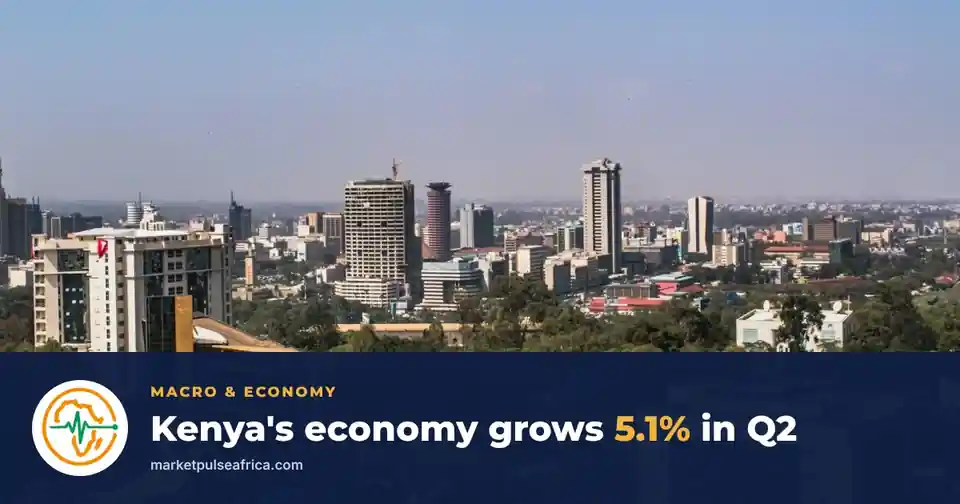
Kenya GDP growth came in at 5.1% year on year in the second quarter of 2026, up from 4.9% in the same quarter of 2025, according to official figures released last week and reported by Capital FM and Trading Economics. The economy held its pace even though the average crude oil price Kenya faced jumped to $104.45 a barrel from $67.44 a year earlier.
On a seasonally adjusted basis, output rose 1.2% from the first quarter, after a 1.3% gain in the previous quarter, Trading Economics reported.
Where Kenya GDP growth came from
Services and power did most of the work. Agriculture, the largest single employer, slowed. Year-on-year growth by sector in Q2 2026, according to Capital FM and Trading Economics:
- Electricity and water supply: 7.7%
- Accommodation and food services: 7.4%
- Information and communication: 7.2%
- Financial and insurance activities: 6.1%
- Construction: 6.0%
- Transportation and storage: 4.4%, up from 3.3% a year earlier
- Agriculture, forestry and fishing: 3.5%, down from 4.0% in Q2 2025
Capital FM attributes part of the farm slowdown to the early end of the long rains. Trading Economics puts first-quarter agricultural growth at 3.8%, so the sector has now decelerated for two quarters in a row.
A note on the first quarter
Trading Economics describes Q2 growth as matching the first quarter. Q1 2026 growth was initially reported at 5.3%, which suggests the earlier figure has been revised down. The statistics office has not been quoted directly on the revision in the reports we reviewed, so treat the Q1 comparison with some caution.
Why oil did not knock growth off course
A 55% rise in the average oil price would normally squeeze a net fuel importer like Kenya through transport costs, the import bill and the shilling. Three things helped absorb it.
Tourism and hospitality. Accommodation and food services grew 7.4%, a sign that visitor spending held up through the period.
Power and digital services. Electricity and water at 7.7% and ICT at 7.2% are less exposed to oil prices and are growing on the back of new capacity and rising mobile and data use.
Credit. Lower borrowing costs earlier in the year fed into lending. Private-sector credit growth stood at 10.6% in September, according to The Rio Times, citing central bank data.
The pressure has shown up elsewhere. Inflation rose to 6.8% in September from 6.6% in August, The Rio Times reported, still inside the Central Bank of Kenya's 2.5% to 7.5% target range but moving toward the top of it. For a wider view of how expensive crude is hitting different economies, see our analysis of which African economies gain and lose with Brent at $110.
What it means for rates, the shilling and investors
The Central Bank of Kenya held its policy rate at 8.75% on October 7, its fourth consecutive hold since the last cut in February, according to The Rio Times. A 5.1% growth print gives the Monetary Policy Committee little reason to cut again while inflation is drifting up and oil remains above $100.
Market indicators going into the release, as reported by The Rio Times:
- Shilling: about KSh129.71 to the dollar on October 1, broadly stable
- Foreign-exchange reserves: $14.93 billion on October 1, about 6.1 months of import cover
- 91-day Treasury bill rate: 8.769% at the October 1 auction
- Average commercial lending rate: about 14.4%
Reserves above six months of cover give the central bank room to keep the shilling steady if oil-driven import demand rises further. For fixed-income investors, a rate hold with T-bill yields near 8.8% and inflation at 6.8% leaves a thin but positive real return at the short end.
Full-year outlook
The Central Bank of Kenya projects 5.0% growth for 2026, while the World Bank recently lifted its forecast for Kenya to 4.6% from 4.4%, The Rio Times reported. Two quarters at or above 5% put the central bank's number within reach. The World Bank also raised its regional outlook, as we reported in our story on its 4.3% growth forecast for Sub-Saharan Africa.
The risks are clear enough. A weak short rains season would extend the farm slowdown into the second half. Oil above $100 for longer would keep inflation climbing toward the 7.5% ceiling. And public debt, which stood at KSh13.01 trillion at the end of June against KSh11.81 trillion a year earlier, limits how much the government can do to cushion either shock.
For now, the Q2 data show an economy that is leaning more on services, power and digital activity and less on the farm, and that is holding a little above 5% while doing it.