Nigeria Domestic Crude Supply: Local Refineries Got 127 Million Barrels in Nine Months, NUPRC Says
Nigeria domestic crude supply topped 127m barrels in January–September 2026, NUPRC said, as output hit 1.717m bpd and a crude swap plan went to consultation.
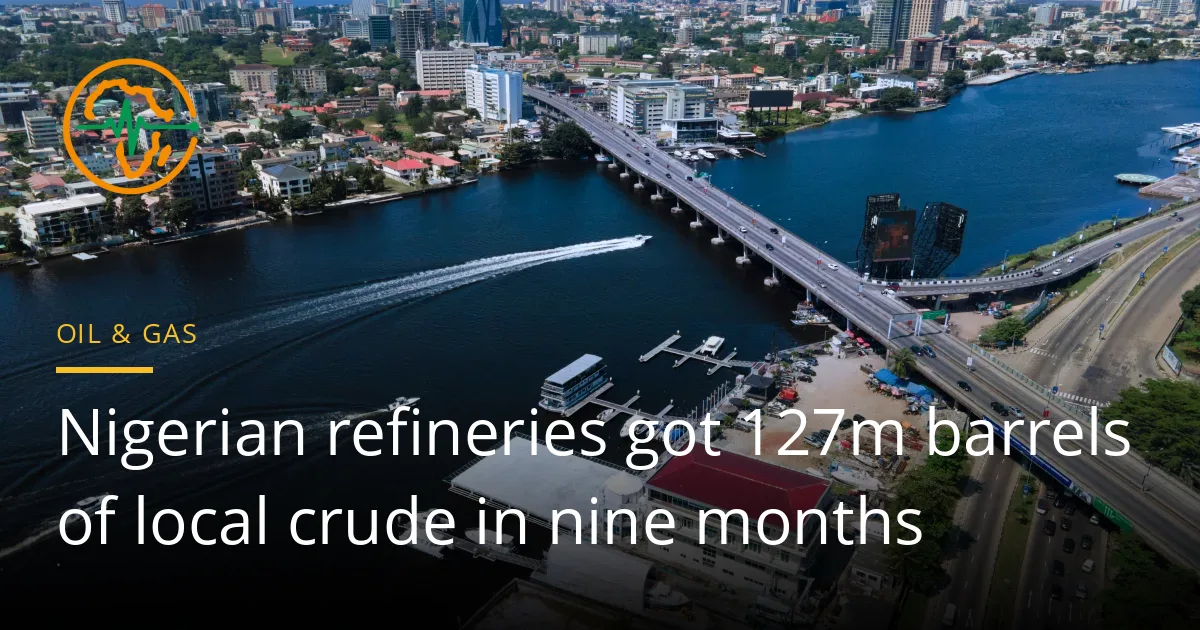
Nigeria domestic crude supply to local refineries passed 127 million barrels in the first nine months of 2026, the Nigerian Upstream Petroleum Regulatory Commission (NUPRC) said on Monday. The figure covers crude oil and condensate delivered to domestic refineries from January to September.
The numbers were presented at the 20th edition of OTL Africa Downstream Energy Week in Lagos, according to a report by Daily Trust. Regulators from both ends of the industry spoke, and between them they described a market where local refining now supplies most of the petrol Nigerians buy, while the data needed to manage that supply is still being built.
Nigeria domestic crude supply and output
NUPRC's figures show production holding up through the third quarter:
- Crude oil and condensate output averaged 1.717 million barrels per day in September, up 2.34% from August.
- Crude oil alone averaged 1.53 million barrels per day, the fifth month in a row that the industry met or exceeded its quota.
- Domestic refineries received more than 127 million barrels between January and September.
Higher output gives the regulator more room to meet domestic supply obligations without cutting into export volumes, which still earn most of Nigeria's foreign exchange.
A crude swap plan to cut costs
The commission is consulting on a domestic crude swap framework. Under the proposal, a refiner could take crude from the nearest suitable delivery point rather than from a specific field or terminal.
NUPRC chief executive Oritsemeyiwa Eyesan said the arrangement "could take an estimated three to four dollars off the cost of every barrel." On a supply base of more than 127 million barrels in nine months, savings of that size would add up quickly for refiners, although the framework is still at the consultation stage and no start date was given.
Eyesan also pointed to the 2026 Licensing Round, which offers 40 blocks with published evaluation criteria and mandatory disclosure of beneficial owners. Under the "drill or drop" principle, 22 recent awardees are expected to add at least 250,000 barrels per day within five years.
Local petrol now covers three in four litres
On the downstream side, the Nigerian Midstream and Downstream Petroleum Regulatory Authority (NMDPRA) said locally refined petrol now accounts for three of every four litres consumed in the country.
Its September figures also show a gap between demand and supply:
- Daily petrol consumption was about 44.4 million litres.
- Daily supply was about 38.7 million litres.
- Existing stocks covered the shortfall.
The authority wants stock cover of 30 to 45 days of national demand. Its chief executive, Rabiu Abdullahi Umar, was blunt about a basic weakness: Nigeria has no reliable data on actual fuel consumption. "No consumption data yet. We are working on this," he said. NMDPRA is working with an IT firm on a tracking system.
Other steps the authority listed include a review of internal licences, a memorandum of understanding with the Federal Competition and Consumer Protection Commission, seven new product-testing laboratories in Port Harcourt with two more due by year-end, and the second revision of the Gas Transportation Network Code.
Dangote's share of the market
Lagos State Governor Babajide Sanwo-Olu told the conference that the Dangote Refinery produced about 42 million litres of petrol a day in August, and that petrol imports fell 26% to about 14.6 million litres a day.
The refinery's weight in the domestic market has been a theme for investors this month. Its share offer drew wide attention, as we covered in our report on the Dangote Refinery IPO's final days. Steady crude supply from local fields is one of the factors that shapes the refinery's margins, so the NUPRC figures and the swap framework matter to anyone weighing its prospects.
Sanwo-Olu also said 152 First and Last Mile buses in Lagos had been converted to compressed natural gas, cutting fuel costs by nearly half, and that 2,000 CNG-powered trucks had been introduced under haulage reforms.
What it means for markets
For investors following Nigerian energy, the conference set out a few points worth tracking:
- Output stability. Five straight months at or above quota supports both export earnings and domestic supply.
- Refiner costs. If the swap framework is adopted, it could lower feedstock logistics costs by $3 to $4 a barrel, according to NUPRC.
- Import substitution. Lower petrol imports reduce demand for dollars, which matters for the naira.
- Data gaps. Without consumption data, supply planning and subsidy debates rest on estimates.
President Bola Tinubu, in a message delivered by Patience Oyekunle, Permanent Secretary at the Ministry of Petroleum Resources, backed the idea of Nigeria as a regional energy hub and called for regional cooperation.
Source: Daily Trust via AllAfrica, 27 October 2026, reporting from OTL Africa Downstream Energy Week in Lagos. This article is for information only and is not investment advice.