Nigeria capital market targets N750 trillion by 2036: the maths and the risks
The Nigeria capital market master plan aims to triple the market to N750 trillion by 2036. Here is the maths, what it means for investors and the main risks.
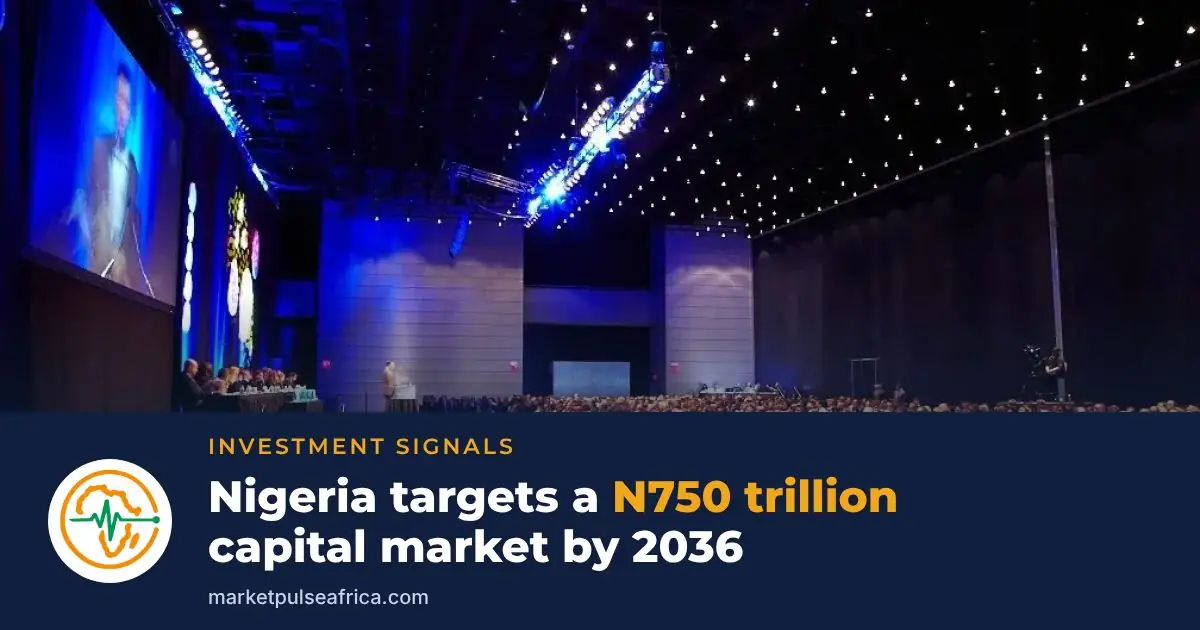
Nigeria wants a capital market three times its current size within a decade. Vice President Kashim Shettima unveiled the Nigerian Capital Market Master Plan 2.0 (NCMMP 2.0) at the National Capital Market Conference 2026 in Abuja on Monday, 19 October. The Securities and Exchange Commission (SEC) wants the Nigeria capital market to grow from about N250 trillion to N750 trillion by 2036, Nairametrics reported.
The News Agency of Nigeria had carried the same N250 trillion to N750 trillion goal in a statement from SEC Director-General Emomotimi Agama on 14 October, ahead of the launch. The plan runs from 2026 to 2036.
What the Nigeria capital market plan targets
The headline number belongs to the SEC. Finance Minister Taiwo Oyedele went further at the conference. He floated a capital market worth $1 trillion by 2036 and set out a list of goals to get there:
- Equity market capitalisation rising from 33% of GDP to at least 60%.
- Listed companies rising from 146 to 250.
- Retail investors rising from 6 million to 20 million.
- Corporate bond issuance growing to more than three times its current share of GDP.
- Sukuk rising from 0.3% of GDP to at least 5%.
- Pension assets rising from 6% to 16%. Nairametrics did not say what this ratio is measured against, though pension assets are usually quoted as a share of GDP.
Oyedele also wants incentives that encourage private companies to list on the Nigerian Exchange without forcing them to sell shares to the public.
Agama announced a National Savings Scheme aimed at traders, farmers, young graduates and other groups, with the money managed by SEC-registered fund managers. He said the scheme has legal backing under the Investments and Securities Act 2025. The SEC has also signed a memorandum of understanding with the Nigeria Revenue Service and FSD Africa to support tax incentives. "Every commitment in NCMMP 2.0 will have an owner, a timeline and a scorecard," Agama said, adding that progress will be reported publicly.
The maths of tripling the market
Going from N250 trillion to N750 trillion in 10 years means multiplying the market by three. That works out to compound growth of about 11.6% a year, assuming a straight 10-year run from 2026 to 2036 and measuring everything in nominal naira.
The starting point matters. Shettima put the combined value of equities and bonds above N217 trillion, below the SEC's N250 trillion baseline. The gap likely reflects a wider definition of the market, but the reports do not explain it. Measured from N217 trillion, the required growth rises to about 13.2% a year.
Two other points shape how hard the target is:
- Inflation. The goal is in nominal naira. If inflation averages close to 11.6% a year over the decade, the market could hit N750 trillion with almost no growth in real terms. If inflation falls well below that, the plan needs real growth from new listings and new money.
- The dollar target. Oyedele's $1 trillion and the SEC's N750 trillion only match if the naira trades at N750 to the dollar in 2036. Any weaker exchange rate means the dollar goal needs a much bigger naira market than the SEC is planning for.
Recent growth was mostly prices
Shettima said the NGX All-Share Index rose from about 55,000 points in May 2023 to more than 260,000 points, and that listed equities grew from about N30 trillion to nearly N160 trillion. He credited fuel subsidy removal, foreign exchange unification, tax reforms and bank recapitalisation.
The index level he cited is above where the market actually closed on the day. The All-Share Index fell 0.91% to 245,278.34 points on 19 October, and market capitalisation dropped N1.47 trillion to N159.26 trillion, according to Nairametrics' market report. Even at that close, the index is about 4.5 times its May 2023 level.
Growth of N30 trillion to about N160 trillion in roughly three and a half years is far faster than 11.6% a year. Most of it came from rising share prices, not from new companies coming to market. The master plan bets on the second source, which is slower and harder to deliver.
What it means for investors
For now, the plan is a set of goals rather than new rules. The parts worth tracking are specific:
- The design of the tax incentives backed by the SEC, Nigeria Revenue Service and FSD Africa agreement.
- Whether the National Savings Scheme brings new retail money into funds and listed stocks.
- New listings. Going from 146 to 250 companies means more than 10 net new listings a year for a decade.
- Bond and sukuk issuance, where the targets imply the biggest jumps relative to today.
Large listings would move the numbers fastest. Senate Committee on Capital Market chairman Osita Izunaso urged the listing of NNPC Limited and the major telecom companies, and called for faster rules on digital assets and tokenisation. We looked at NNPC's governance and reporting gaps in our earlier piece on NNPC's IPO plans.
The risks
Shettima himself flagged the biggest one. He warned that policy reversals could undermine investor confidence. The gains since 2023 rest on reforms such as FX unification and subsidy removal, and a retreat from either would hit valuations directly.
Supply is the second risk. A shortage of credible issuers would push money into the same small group of stocks, lifting prices rather than deepening the market. If new listings do not arrive, the market could hit its naira target through inflation and higher prices while staying narrow.
The third is measurement. The plan's baseline, the officials' market figures and the exchange's own closing data do not line up neatly. Agama's promise of an owner, a timeline and a scorecard for each commitment will only help investors if the scorecard uses consistent, published numbers.