
Nigeria’s cash transfers need an audit trail, not just tighter controls
Nigeria has drawn most of its World Bank social safety-net financing and introduced stricter identity checks. Public trust still hinges on proof that the money reached eligible households and that failures were corrected.
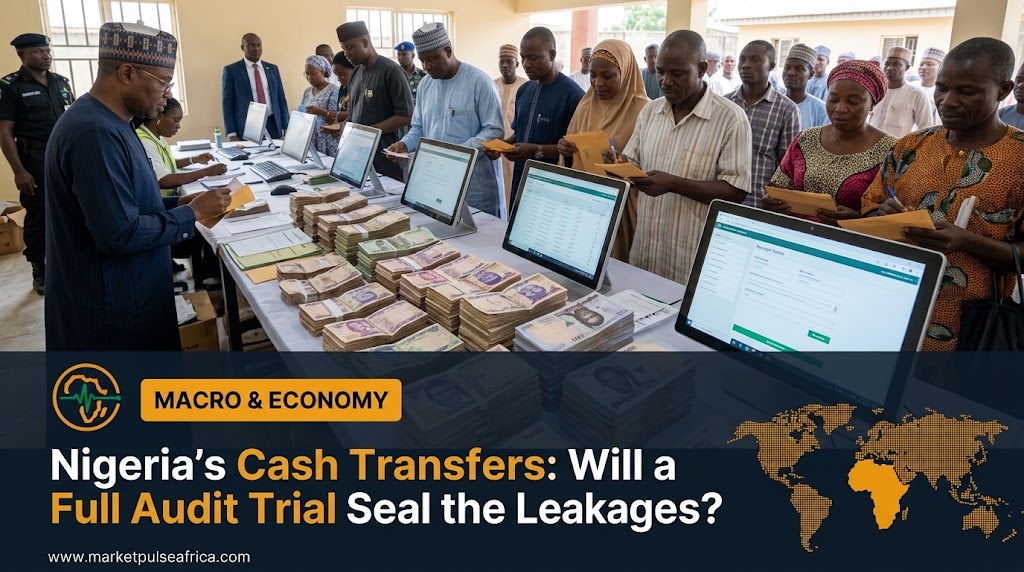
Nigeria’s cash-transfer programme will not regain public confidence simply by adding more identity checks or by drawing down the remaining World Bank funds. It must show, independently and in public, that the intended households received the payments, that failed transactions were fixed, and that the money produced measurable relief.
Without that evidence, tighter controls risk becoming another administrative claim in a programme whose credibility depends on what happens after the funds leave government accounts.
Scale of the Programme
The Federal Government has drawn about $744.61 million from the World Bank’s $800 million National Social Safety Net Programme-Scale Up facility. That represents 93.1 percent of the approved financing.
Government figures have placed the number of people reached by cash-based interventions in the tens of millions. One World Bank-linked update put coverage at more than 67 million people and over 10 million households by August 2026. The Ministry of Humanitarian Affairs has also reported that roughly 9.2 million people benefited from the Household Prosperity and Empowerment Cash Transfer Programme, with about N688 billion disbursed over two years.
These large numbers make the absence of a clear, publicly reconcilable payment trail especially consequential.
The Audit Gap
The Office of the Auditor-General for the Federation has questioned N33.75 billion in electronic cash transfers made in 2023 to 3.29 million households and beneficiaries across 35 states. Auditors reported that payment vouchers lacked full beneficiary details and that a Remita statement matching actual recipients against the National Social Register and National Beneficiary Register was not presented.
As a result, the auditors said they could not independently confirm that the recipients were the genuine listed beneficiaries. The National Cash Transfer Office has disputed parts of the findings and stated that digital records and emails transmitting the registers were available. The disagreement itself underlines the core problem: the public cannot see a complete, reconciled trail.
Civil-society groups and opposition voices have called for full publication of beneficiary lists, payment records and failed-transaction data. The absence of that information continues to fuel suspicion even as new controls are announced.
Controls Alone Are Not Enough
Authorities have responded to earlier controversies by tightening verification. Registration with Bank Verification Numbers and National Identification Numbers was made mandatory. The Finance Minister was tasked with reviewing social investment programmes. Partnerships with the Central Bank and the identity agency were expanded.
These steps address entry into the system. They do not automatically prove that money left the payment platform and reached the right accounts, or that unsuccessful transfers were reversed and reissued. An audit trail requires regular, published reconciliation of funds received, administrative costs, payments authorised, payments confirmed, failed transactions and outstanding complaints.
What Accountability Requires
The immediate priority is transparency for the resources already committed. Government should release reconciled reports that allow independent verification of who was paid, how much, and when. Failed or reversed transactions should be listed and explained. State-by-state and tranche-level breakdowns would help the public and oversight institutions test the claims of coverage.
Longer-term design should keep the focus on matching assistance to need and expanding household choices rather than locking beneficiaries into a single pathway. But design improvements will not restore trust if the basic evidence of delivery remains incomplete.
Public Trust and Programme Effectiveness
Cash transfers can reduce hardship when they reach the intended people on time. When the delivery chain cannot be verified, the same programmes become a source of political controversy and cynicism. Nigeria has already committed the bulk of the current World Bank facility. The remaining task is to show, with records that outsiders can examine, that the money produced the relief it was meant to deliver.
Until that audit trail exists and is made public, tighter controls will remain necessary but insufficient.