JPMorgan Merchant Bank Nigeria: CBN Gives In-Principle Approval as N50bn Deposit and Seven-Member Board Are Cleared
JPMorgan merchant bank Nigeria plan clears its first CBN hurdle: approval in principle, a reported N50bn deposit and Dapo Olagunju named managing director.
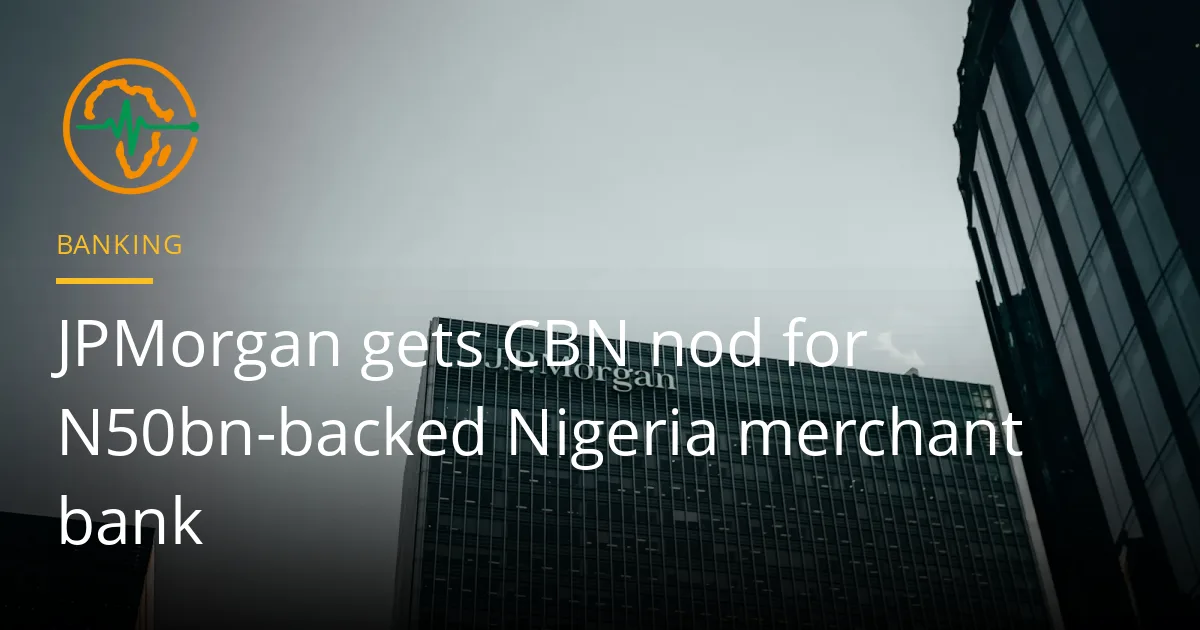
The JPMorgan merchant bank Nigeria project has cleared its first regulatory gate. The Central Bank of Nigeria (CBN) has granted JPMorgan an approval in principle to set up JPMorgan Merchant Bank Nigeria Limited, according to an announcement by Michael Akuka, director of the CBN's Corporate Communications and Investor Relations Department, reported by Nairametrics on 23 October.
BusinessDay reports that this would be the largest US bank's first merchant banking operation anywhere in Africa. The regulator also cleared seven nominees for the proposed board, led by a Nigerian managing director who has run the group's West African business since 2018.
The approval is a first step, not a licence. Here is what has happened, what is still missing, and why investors and corporate treasurers in Nigeria should pay attention.
What the CBN approved for the JPMorgan merchant bank in Nigeria
An approval in principle is the opening stage of the CBN's licensing process. Nairametrics notes that the bank cannot start business until it meets the regulator's remaining requirements, incorporates with the Corporate Affairs Commission, completes its operational set-up and receives a final banking licence.
BusinessDay puts it plainly: "The approval-in-principle, however, is not a final banking licence."
Money has already moved. Nairametrics reported on 20 October that JPMorgan had deposited N50 billion, about $38 million, with the CBN while the application progressed. That deposit relates to the capital requirement for a merchant bank with a national licence.
JPMorgan has operated in Nigeria for years through a representative office in Lagos. A representative office can market and liaise, but it cannot run a full banking book locally. The plan is to turn that office into an operating business that can serve Nigerian corporate and institutional clients directly.
Who will run it
The CBN cleared seven board nominees: one managing director, three non-executive directors and three independent non-executive directors. According to Nairametrics, the list is as follows.
- Managing director: Adedapo "Dapo" Olagunju
- Non-executive directors: Latter Kevin George, Chinedum Nzelu Izunwanne and Syed Gabriel Murtaza
- Independent non-executive directors: Sarah Omotunde Alade, Olukonyinsola Ajayi and Seni Adetu
Dapo Olagunju, managing director
BusinessDay's profile shows a career built in Nigerian treasury desks. Olagunju was chief dealer at IBTC (later Stanbic IBTC) from 2000 to 2003, then treasurer at Access Bank. After a short United Nations consultancy in New York in 2006, he returned to Access Bank as group treasurer, a role he held until January 2018, adding head of global markets from 2017. He joined JPMorgan in January 2018 to lead its West African business. He holds an Oxford MBA and is a fellow of the Institute of Chartered Accountants of Nigeria.
He first spoke publicly about the merchant banking plan at the Nigeria-Asia Financial Connectivity Dialogue in Singapore in early October, BusinessDay reports.
The independent directors
Sarah Alade brings the regulator's view. She was a CBN deputy governor from 2007 to 2017, served as acting governor in 2014 and later became special adviser to the president on finance and the economy.
Olukonyinsola Ajayi is a partner at law firm Olaniwun Ajayi. BusinessDay cites his work on Airtel Africa's $750 million dual listing in London and Lagos and on Seplat's purchase of Eland Oil and Gas.
Seni Adetu is a former managing director and chief executive of Guinness Nigeria and a former chief executive of East African Breweries. He has sat on the boards of FBN Holdings and Fidelity Bank.
Chinedum Izunwanne, a non-executive director, is JPMorgan's global head of macro electronic trading. He joined the bank in London in 2005 and became a managing director in 2016.
Why a merchant bank, and why now
A merchant banking licence in Nigeria allows a bank to serve large companies, governments and institutions with lending, treasury, foreign exchange and advisory services, without running a retail branch network. That fits JPMorgan's global model, which leans on corporate and investment banking.
The CBN tied the approval to its completed bank recapitalisation exercise and to reforms under Governor Olayemi Cardoso. Nairametrics quotes Cardoso saying: "Our objective is to build a financial system that is stable, competitive and internationally connected."
The timing also matters for markets. Nigeria has spent much of 2026 trying to attract foreign portfolio money back into naira assets, with heavy demand at bond auctions. In October the Debt Management Office sold N1.21 trillion of FGN bonds in a single auction, as we reported in our coverage of the October bond sale. A locally licensed JPMorgan unit would sit close to that flow.
What it means for Nigerian markets
For corporate treasurers, a local JPMorgan balance sheet could mean another counterparty for naira and dollar liquidity, trade finance and hedging. For the FX market, more foreign banks with local books can add depth, though one new merchant bank will not change the supply of dollars on its own.
For existing merchant banks such as FBNQuest, Coronation, Rand and Nova, the entry of a global name raises the bar on talent and pricing for large corporate mandates. The board line-up, with a former CBN deputy governor and a senior capital markets lawyer, shows JPMorgan expects close regulatory and deal scrutiny.
There are open questions. Neither report gives a launch date. The CBN statement did not set out the full capital the bank will hold once licensed, and JPMorgan itself has not issued a public statement, according to Nairametrics.
What to watch next
- Incorporation with the Corporate Affairs Commission, which is a stated precondition.
- The CBN's final licence decision and any conditions attached to it.
- Whether JPMorgan names the first products and client segments for the Lagos unit.
- How quickly the bank becomes an active dealer in the Nigerian foreign exchange and bond markets.
If the final licence follows, JPMorgan Merchant Bank Nigeria would be one of the clearest signs yet that global lenders see Nigeria's reforms as durable enough to commit capital on the ground, rather than serving the market from London or Johannesburg.