Nigeria Foreign Loans: Tinubu Asks the Senate for $20.52 Billion and €1.05 Billion, With No Project List Attached
Nigeria foreign loans request: Tinubu wants Senate approval for $20.52bn and €1.05bn for 2026–2027. What the letter says, what it leaves out, and what's next.
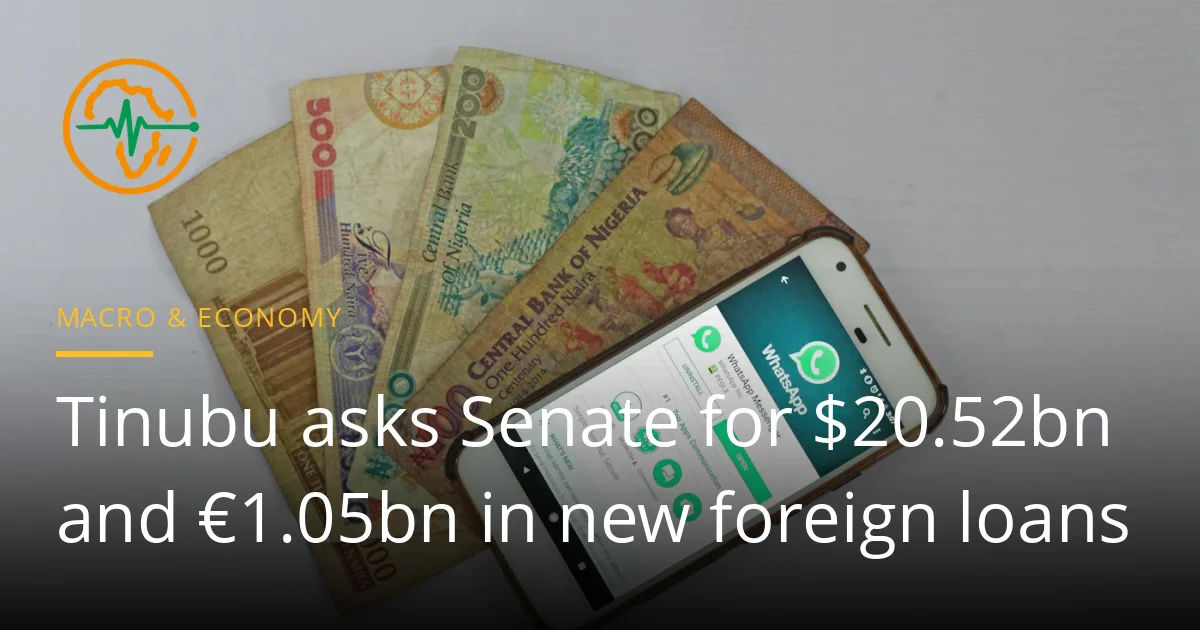
President Bola Tinubu has asked Nigeria's Senate to approve a new round of foreign loans worth $20.52 billion and €1.05 billion. The request, read on the Senate floor on Tuesday, 27 October 2026, is framed as a supplementary external borrowing plan for the 2026–2027 period. It arrives with a list of sectors but no breakdown by project, lender or cost, and the opposition has already asked lawmakers to block it.
For investors in Nigerian debt and the naira, the size matters. So does the timing, a little over a year before the 2027 general election.
What the Nigeria foreign loans request contains
According to Vanguard, the letter gives the exact figures as $20,517,755,901 and €1,045,083,643. (One passage in the reproduced letter shows $20,517,000,000; Vanguard's own figures use the longer number.)
The letter says the money would fund infrastructure and development projects in:
- Power
- Transportation
- Agriculture
- Healthcare
- Education
- Water supply
- Security
It also cites growth, job creation and financial management reforms, and says most projects would run across the 36 states and the Federal Capital Territory. Tinubu wrote that the projects were selected after technical and economic evaluation and that the borrowing is needed to close Nigeria's infrastructure financing gap.
What the letter leaves out
Vanguard reports that the letter did not include:
- A project-by-project list.
- The names of lenders.
- Financing terms such as interest rates, tenors or grace periods.
- How much would go to each sector.
For bond investors, the missing terms are the gap that matters. Concessional loans from development banks carry very different costs from commercial borrowing, and the letter does not say which mix the government has in mind.
How the Senate will handle it
Senate President Godswill Akpabio read the letter in plenary and referred it to the Senate Committee on Local and Foreign Debts, which is to report back within one week. Vanguard says the committee may work with the Appropriations Committee and other relevant committees.
The Senate has approved large external borrowing plans for this administration before. That record makes approval the more likely outcome, though the political pressure this time is louder.
Opposition: "not a single dollar"
BusinessDay reports that the African Democratic Congress (ADC) and its presidential candidate, Atiku Abubakar, have urged the National Assembly to reject the request.
Kola Ologbondiyan, director of media and publicity for the ADC presidential campaign council, asked: "What exactly is President Tinubu borrowing all this money for?" The party wants a full account of domestic and foreign loans taken since 29 May 2023, and of how savings from the removal of the petrol subsidy were spent.
In a statement through his aide Phrank Shaibu, Atiku alleged that the borrowing could finance political campaigns and benefit favoured contractors ahead of the 2027 vote. "The National Assembly must not approve a single dollar until the President publishes every project," he said, calling for project details, contracts, costs, contractors, loan terms and repayment obligations to be made public.
These are political claims and the presidency had not answered them in the reports cited here.
What it means for markets
Three things are worth watching for investors.
Supply and yields
If a meaningful part of the package comes from Eurobonds or other commercial sources, it adds to Nigeria's dollar debt supply. Local yields are already high: Market Pulse Africa reported last week that the Nigerian 10-year bond yield climbed to 17.05%, while the DMO sold N1.21 trillion at its October FGN bond auction. More external borrowing could ease pressure on the domestic market, but it shifts risk onto foreign currency.
The naira
Foreign loan inflows can support reserves and the currency in the short term. Over time, the same loans must be serviced in dollars or euros. The naira recently had its sharpest one-day fall in 18 months, to N1,365 per dollar, according to Nairametrics data we reported on 23 October. Debt service in hard currency adds to the demand for dollars that drives such moves.
Ratings and transparency
Rating agencies and bond investors pay attention to how borrowing is disclosed. A request with no lender names or terms makes it harder to judge debt sustainability. The detail released when the committee reports back will tell the market more than the headline number.
What happens next
- Committee report. The Senate committee is due to report within one week of the referral.
- House of Representatives. External borrowing plans normally need approval from both chambers.
- Disclosure. Watch for a project list, lender names and terms, which the opposition is demanding and investors need.
- DMO data. The next Debt Management Office public debt update will show how the new borrowing would sit against existing obligations.
Market Pulse Africa will update this story when the committee reports.
Sources: Vanguard (27 October 2026); BusinessDay (28 October 2026).