NGX gains nearly 60% this year after FTSE frontier reclassification
The NGX All-Share Index has gained nearly 60 percent this year after Nigeria's return to FTSE frontier status. Here is what the reclassification did, which heavyweights are leading, and what could reverse the gains.
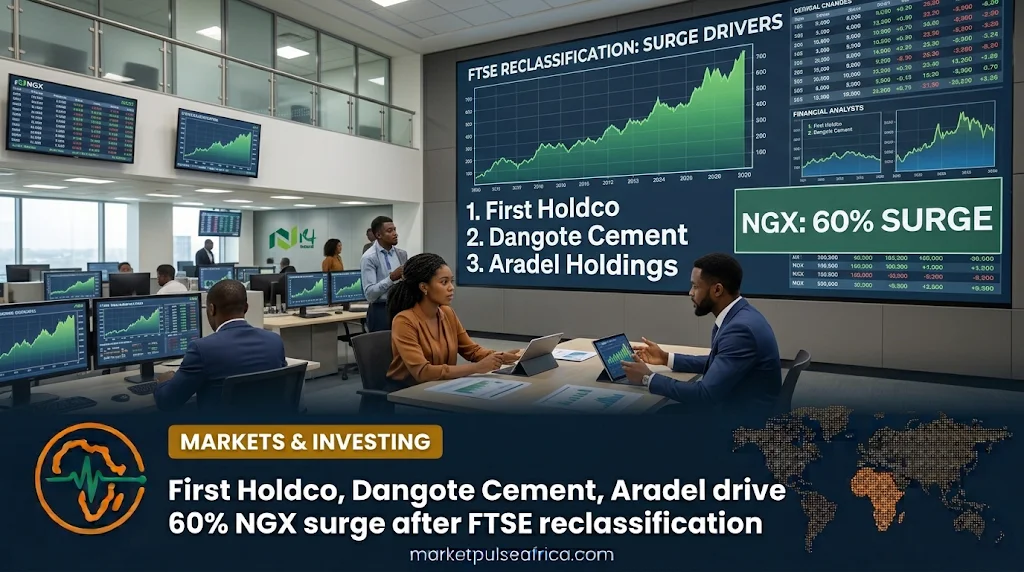
The NGX All-Share Index has gained between 58 and 60 percent this year in naira terms, and more than 70 percent in dollar terms, as Nigeria returned to FTSE Russell's frontier market classification. BusinessDay named First Holdco, Dangote Cement and Aradel Holdings among the heavyweights leading the rally, alongside Zenith Bank, GTCO, Nestlé Nigeria and Nigerian Breweries. The reclassification took effect on September 21, 2026, when ten Nigerian companies also entered the FTSE Frontier Index Series. The index's gain is a market-wide figure, not the return of any single stock, and the sources reviewed do not give individual year-to-date percentages for the three names. This article explains what the reclassification means, what has and has not been confirmed about the rally, and what could change the picture from here.
Contents
- The size of the rally
- What the FTSE reclassification did
- The heavyweights leading the market
- What is driving the gains
- Risks to the rally
- What to watch
The size of the rally
According to BusinessDay, the All-Share Index gained between 58 and 60 percent year to date in local currency terms. In dollar terms, returns exceeded 70 percent. The index stood at 250,156.80 points on September 21, the day the reclassification took effect, when total market capitalisation crossed N162 trillion.
The figure is a market-wide measure. It does not show how much any single stock has risen, and it is not the combined return of the stocks named in the headline. Investors should not read the headline as a claim that three companies produced most of the gain.
What the FTSE reclassification did
FTSE Russell moved Nigeria from "Unclassified" to "Frontier Market" status, effective from the opening of trading on September 21, 2026. The process began in October 2025, when FTSE Russell placed Nigeria on its watch list after improvements in foreign exchange liquidity, capital repatriation and market access. The reclassification was delayed for further assessment after Nigeria moved to a T+1 settlement cycle on June 1, shortening the period between a trade and its completion from two days to one.
Ten Nigerian companies were added to the FTSE Frontier Index Series: Aradel Holdings, Dangote Cement, First HoldCo, GTCO, MTN Nigeria, Nestlé Nigeria, Nigerian Breweries, Presco, Stanbic IBTC Holdings and Zenith Bank.
Index inclusion matters because funds that track the index buy its constituents. That creates demand that does not depend on the company's fundamentals, and it can attract attention from international investors who follow frontier markets.
The heavyweights leading the market
BusinessDay named First Holdco, Dangote Cement and Aradel Holdings as the names driving the rally, with Zenith Bank, GTCO, Nestlé Nigeria, Nigerian Breweries and Presco among the other large-cap stocks. The mix spans banking, cement, energy and consumer goods, which suggests the gains are not confined to one sector.
The sources reviewed do not give year-to-date percentages for the individual stocks named, so readers should check each company's price history before drawing conclusions about its performance.
What is driving the gains
BusinessDay attributed the rally to a combination of improved investor sentiment, expectations around the reclassification and strong price appreciation among large caps. Those are three different drivers. Sentiment is hard to measure. Reclassification expectations can fade once the event passes. Large-cap appreciation can be driven by earnings, by index flows or by both, and the sources do not separate those effects.
Market-wide gains of this size can also reflect a recovery from earlier lows, rather than a steady rise. Investors should look at the index's path over the year, not only its year-to-date figure.
Risks to the rally
The market has already shown how quickly it can reverse. Nairametrics reported in October that the NGX lost N1.47 trillion in one session before recovering part of that loss the next day, and a separate BusinessDay headline described investors losing N3.52 trillion in a five-day slump as large-cap stocks fell. Those episodes show that large-cap concentration works in both directions.
Concentration is a real issue. When a small group of heavyweight stocks drives an index, a sell-off in those names can move the whole market, even if most smaller stocks are steady. Index flows also reverse. Funds that bought after the reclassification may sell if their mandates change or if they take profits.
There is also the question of what the reclassification has changed beyond sentiment. Frontier status improves access and market standards, but it does not guarantee that foreign capital will return in size. Currency convertibility, repatriation and the naira's exchange rate remain important.
What to watch
Three things will show whether the rally has a lasting base. The first is whether foreign portfolio flows follow the index inclusion, which should show up in trading volumes and in the custody data the NGX publishes. The second is earnings: whether the heavyweight companies' reported profits support their share prices. The third is how the index behaves if oil prices or the naira move sharply, since several of the leading names are sensitive to those factors.
For investors, the reclassification changes the market's profile, but it does not remove the need to check each stock's fundamentals, liquidity and valuation before buying.
This article is general information, not personal financial advice. Check each company's latest filings and the NGX's published data before making a decision.