
Private Equity Buyouts: Exit Route Analysis across Trade Sales and Secondary Market Deals
Trade sales made up 53% of African private equity exits in Q2 2026, while IPOs stay rare and secondaries hold near 30%. Here is how the three exit routes compare and what the mix means for fund liquidity.
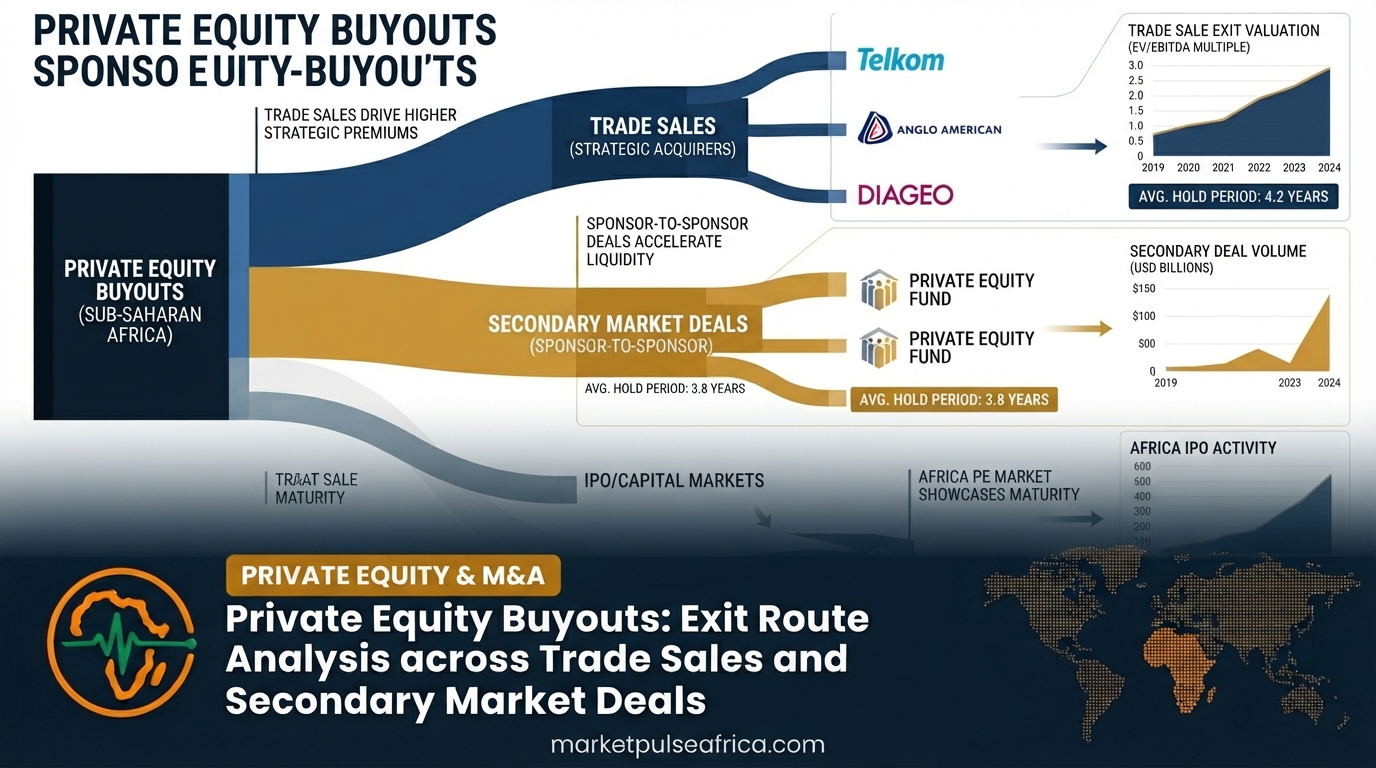
African private equity is selling more companies, but the buyers are almost always the same type. In the second quarter of 2026, trade buyers accounted for 53% of exits, and listings barely register.
African private equity exits held at 34 transactions in Q2 2026, with trade sales at 53% of the total, nearly double the share a year earlier, and local corporates behind two-thirds of strategic acquisitions; secondary sales between funds make up about 30% of exits over the past decade, and IPOs remain rare. For limited partners, the route a fund uses to exit matters as much as the number of exits.
This brief compares the three main exit routes, sets out the latest figures from AVCA and others, and explains what the mix means for returns and liquidity.
- The latest exit numbers
- Trade sales
- Secondary buyouts
- IPOs and public markets
- Exit routes compared
- What it means for investors
- Related Reading
The latest exit numbers
AVCA's Q2 2026 African Private Capital Report shows exit activity holding at 34 transactions, with trade sales nearly doubling year on year to 53% of exits. A legal bulletin from PEVCA Nigeria citing AVCA data records 81 African exits in 2025 and 25 in the first quarter of 2026.
More exits do not mean more cash back to investors. BusinessDay, citing AVCA, reported that trade buyers made up 38% of 2025 exits and 88% of venture exits in the first quarter of 2026, and that headline exit counts are rising while limited partners are not enjoying the liquidity. Exit conditions top the concerns of 73% of limited partners and 62% of general partners in AVCA's 2026 sentiment survey.
Takeaway: exit volume has recovered, but it relies on one buyer type, and that limits how quickly and at what price funds can sell.
Trade sales
A trade sale is the sale of a portfolio company to a strategic buyer, usually a larger company in the same sector. Boston Consulting Group's 2025 exit report found trade sales account for 40% to 60% of exits, in line with global trends.
The route offers immediate liquidity and can command a premium when the buyer sees synergies. The risk is concentration. In venture, AVCA's 2025 report said trade sales accounted for over 70% of both exit volume and value.
The buyer mix is also shifting toward African companies. The Q2 data shows local corporates behind two-thirds of strategic acquisitions.
Secondary buyouts
In a secondary buyout, one fund sells to another. BCG's data shows secondaries rising over the last decade from 15% to 30% of exits. AVCA logged 20 PE-to-PE exits in 2024 alone.
Serrari's mid-year review lists a 30 June 2026 secondary buyout in regional insurance broking, involving Adenia and Minet with Capitalworks exiting, with terms not disclosed. Funds like secondaries for speed and flexible deal structures. The drawback is that the new owner needs its own exit later, so the same company can sit in the PE system for another cycle.
IPOs and public markets
The public route is the weakest. BusinessDay's data shows Africa has recorded years with no PE-backed IPOs, and only one IPO among 44 exits in 2019.
There are signs of reopening for the largest names. The SAVCA 2026 survey said public markets had reopened for larger, high-growth private capital-backed businesses in Southern Africa, while trade sales re-emerged as the leading route. Nigeria's 2025 exits included two IPO or capital markets exits out of 11.
Listing remains linked to the health of the local equity market, which we cover in our report on the NGX surge after the FTSE frontier reclassification.
Exit routes compared
Trade sale
- Share of exits: 40% to 60% (BCG), 53% in Q2 2026 (AVCA)
- Strength: immediate liquidity, possible premium
- Weakness: few buyers, negotiated bilateral price
Secondary buyout
- Share of exits: about 30% over the decade
- Strength: speed, flexible structures
- Weakness: passes the exit problem to the next fund
IPO
- Share of exits: rare, with zero-IPO years on record
- Strength: public price discovery, partial exits possible
- Weakness: depends on market conditions and company size
What it means for investors
Nigeria shows the pattern in miniature. The country recorded 11 exits in 2025, up from eight in 2024: three trade sales, two sales to financial buyers, two management buyouts or private sales, two IPO or capital markets exits, one other and one write-off. Over the 2021 to 2025 series, trade buyers made up 17 of 36 exits.
- Ask what share of a fund's exits were trade sales. A track record built on one buyer type is exposed if that buyer pulls back.
- Check for disclosed proceeds. Serrari's July 2026 review found exits improved but remained trade-sale led, with few disclosed proceeds.
- Look at fund duration. Secondaries can extend how long a company stays inside the PE system.
- Track pension fund appetite. Large local institutional buyers could widen the exit market, a theme in our coverage of Nigeria's pension reforms.
Related Reading
- Read our full coverage of the NGX surge after the FTSE frontier reclassification
- Read our full coverage of NGX insurance recapitalisation and consolidation risk
- Read our full coverage of Nigeria's Minimum Pension Guarantee
Is your fund's exit plan built on one type of buyer? Keep following Market Pulse Africa for the next AVCA exit data.