Ghanaian Cedi (GHS) Tracking: Sovereign Debt Restructuring and FX Reserve Accumulation
The Ghanaian cedi has lost about 10% against the dollar in 2026 despite a trade surplus and reserves above US$12 billion. Here is what drove the move and how the Bank of Ghana's reserve programme is holding the line.
Ghana's central bank holds more than US$12 billion in reserves and the economy runs a large trade surplus, yet the cedi has lost about a tenth of its value against the dollar this year. That mismatch is the puzzle behind the 2026 cedi story.
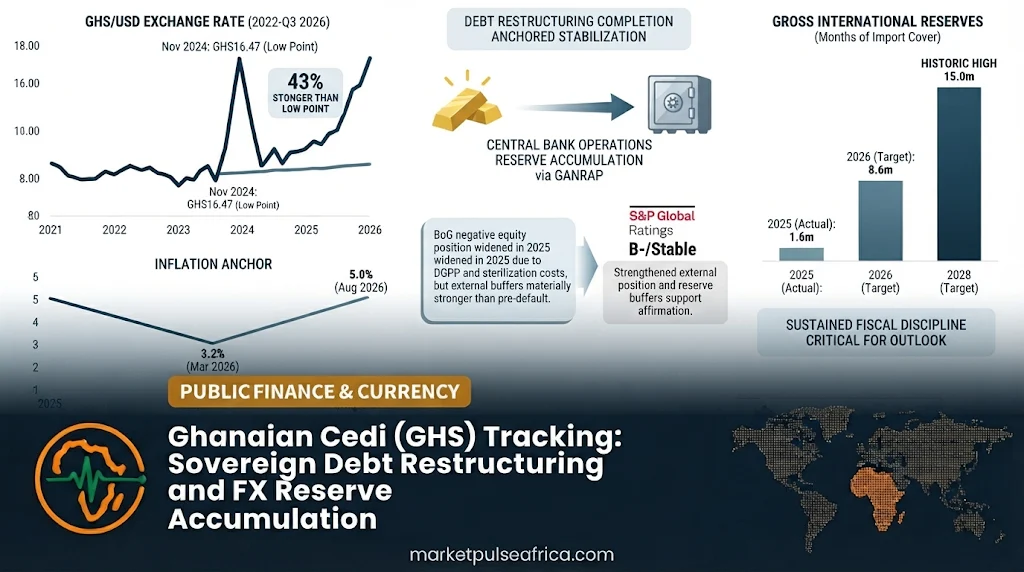
The cedi has depreciated about 10% against the US dollar so far in 2026 (10.07% by the end of October, per Databank), after rising 40.7% in 2025, while the Bank of Ghana's gross reserves fell from US$13.8 billion at end-2025 to US$11.07 billion at end-August before recovering to US$12.05 billion by 22 September. The bank has sold dollars heavily to steady the currency and has set a target of 15 months of import cover by 2028.
This brief covers what drove the move, how the reserve programme works, and the indicators that decide where the cedi goes next.
- From appreciation to depreciation
- What drove the 2026 pressure
- The reserve accumulation programme
- The cost of intervention
- Indicators to watch
- Related Reading
From appreciation to depreciation
The cedi's 2025 was exceptional. According to Bank of Ghana data reported by the press, it closed 2025 at GH¢10.45 per dollar, an appreciation of 40.7% for the year. The IMF put the nominal effective appreciation at the same 40.7% and noted reserves of almost six months of import cover at year-end.
The reversal came quickly. The cedi was 8.4% weaker by mid-May and, per the Bank of Ghana's governor, 9.5% weaker after nine months, though with the lowest volatility in four years. Databank's data showed the year-to-date loss at 10.07% at the end of October. Mid-November quotes were around GH¢11.84 to GH¢12.16 per dollar.
Takeaway: the decline was steady rather than disorderly, and the main risk in the numbers is the level of reserves used to hold it.
What drove the 2026 pressure
The governor attributed the depreciation to higher energy-related import payments, dividend repatriation and global risk aversion linked to the Middle East conflict. Oil is the clearest driver. Brent averaged US$103.20 a barrel in April, up 67.4% year-to-date, which raised Ghana's fuel import bill.
The World Bank's October Africa Economic Update named the cedi the weakest currency on the continent between March and June, with a fall of nearly 10%, and said surging oil prices swelled import bills across energy-importing economies.
Gold ran the other way. The bullion price rose 9.4% in the year to April, to US$4,724.10 an ounce, which supported export earnings. Ghana's trade surplus was US$8.81 billion in the first half. The cedi fell despite both.
The reserve accumulation programme
Parliament adopted the Ghana Accelerated National Reserve Accumulation Policy in February 2026. It targets 15 months of import cover by 2028, to be met mainly through domestic gold purchases. The programme, known as GANRAP, became operational in April 2026.
The reserve path so far in 2026
- End-2025: US$13.8 billion gross reserves
- April: US$13.95 billion, 5.5 months of import cover
- End-June: US$12.94 billion, 5 months
- End-August: US$11.07 billion, 4.2 months
- 22 September: US$12.05 billion, 4.5 months
Reserves therefore dropped by about US$3 billion between January and August, a loss commentators described as a drop from 5.7 to 4.2 months of cover, before partly recovering on strong export performance.
The gold link is a vulnerability as well as a strength. Ghanaian commentators have asked whether the state gold buyer can keep financing purchases, whether commercial banks can keep receiving enough foreign exchange, and whether the Bank of Ghana can hold adequate reserves while doing so. For a comparison with another African reserve regime, see our report on the XAF/XOF parity mechanism and reserve structure.
The cost of intervention
The IMF disclosed that the Bank of Ghana sold US$12.9 billion on the foreign exchange market in the year to end-May 2026, about US$1.1 billion a month. That is the scale of the support behind the "stable" exchange rate.
There are two costs. The Bank of Ghana reported a book loss of GH¢17.5 billion on its gold holdings, linked to the cedi's appreciation earlier in the year. And a March 2026 transfer of government bonds with a face value of GH¢5 billion to cover those losses breached a ceiling on central bank claims on the government, which is a performance criterion in Ghana's IMF programme.
Ghana is otherwise in a stronger credit position than a year ago, as we explain in our coverage of sovereign debt restructuring under the Common Framework.
Indicators to watch
- Monthly FX intermediation. The central bank plans US$1.2 billion in November, of which US$800 million is earmarked for commercial bank auctions, according to Databank.
- Import cover. A move back above 5 months would ease pressure. A new fall below 4 months would raise it.
- Year-end forecast. Databank expects the cedi at GH¢12.20 per dollar by the end of 2026.
- Christmas import demand. The Bank of Ghana expects the cedi to stay relatively stable despite seasonal dollar demand and says it is ready to intervene.
- Gold price. It drives both export revenue and the value of the reserves held in bullion.
Related Reading
- Read our full coverage of the Common Framework and African sovereign debt
- Read our full coverage of the XAF/XOF parity mechanism and reserve structure
- Read our full coverage of BEAC foreign exchange allocation and remittance delays
Is a 10% annual fall in the cedi manageable for your Ghana exposure? Keep following Market Pulse Africa for the next Bank of Ghana reserve release.