External Debt Restructuring Frameworks: Common Framework Process Analysis for African Borrowers
Chad, Ghana and Zambia have largely finished restructuring under the G20 Common Framework, Ethiopia struck a bondholder deal in June 2026, and Senegal has now asked to join. Here is how the four cases compare and what they mean for investors.
Four African governments have used the G20 Common Framework to restructure their external debt, and by late 2026 three of the four cases are close to finished. The fourth, Ethiopia, only reached a bondholder deal in June, and a fifth country has now asked to join.
Chad, Ghana and Zambia have largely completed restructurings under the Common Framework, Ethiopia reached an agreement in principle with bondholders on 28 June 2026 after its first deal was rejected, and Senegal has requested treatment while excluding its CFA franc debt. The timelines ran from about two years for Ghana and Chad to 3.5 years for Zambia and nearly six for Ethiopia.
This brief compares the four cases, explains the comparability-of-treatment dispute that slowed Ethiopia, and sets out what the Senegal request means for borrowers and bondholders.
- Four cases, four timelines
- How the framework works
- Why Ethiopia took longest
- Ghana and Zambia near the end
- The Senegal test
- What it means for investors
- Related Reading
Four cases, four timelines
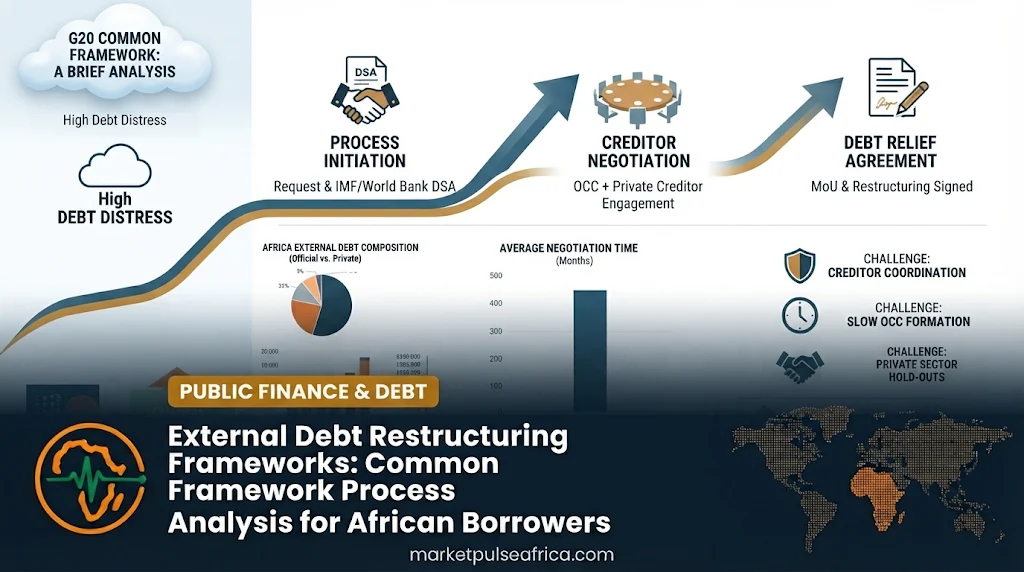
Only four countries applied under the framework after its 2020 launch: Chad, Zambia, Ghana and Ethiopia. The Center for Global Development counts about two years for Ghana and Chad, three and a half for Zambia, and almost six for Ethiopia.
Where each case stands
- Chad: restructured in 2022 with no bondholder haircut, and now largely complete.
- Ghana: suspended most external debt payments in December 2022, and is near full completion with residual commercial creditors.
- Zambia: defaulted on its Eurobonds in November 2020, completed its last IMF programme review, and is negotiating with a small group of non-bonded commercial creditors.
- Ethiopia: defaulted in December 2023 on its only Eurobond, and agreed terms with bondholders in principle on 28 June 2026.
The Global Sovereign Debt Roundtable's April 2026 progress report said most cases that began in 2021 and 2022 were now largely complete, with only residual commercial creditors left, except Ethiopia.
Takeaway: the framework has delivered completed restructurings, but the average case took between two and six years, and the speed depended on how fast private creditors agreed.
How the framework works
The Common Framework brings official creditors, including China and Paris Club members, into a single committee. The IMF sets the amount of debt relief a country needs through its debt sustainability analysis. The borrower must then seek terms from private creditors that are no less generous than those from official creditors, a rule called comparability of treatment.
The Paris Club said in June 2026 that the framework needs fixing to make it faster and more efficient, while noting that Ghana, Zambia and Chad had largely completed their cases. The CGD's own verdict is that procedures are improving but decisions still lack transparency, timeliness and contestability.
Why Ethiopia took longest
Ethiopia missed a US$33 million coupon in December 2023 on a US$1 billion Eurobond issued in 2014. Talks with bondholders broke down in October 2025. A preliminary agreement reached on 2 January 2026 cut the bondholders' nominal claim by 15%, excluding past-due interest, according to the FERDI analysis.
The official creditor committee, co-chaired by France and China, rejected those terms because they failed the comparability of treatment test, meaning bondholders were getting a better deal than official lenders. Ethiopia submitted a revised offer, and the agreement of 28 June 2026 won IMF backing.
The dispute shows the main tension in the design. Private creditors can walk away from a deal that official creditors then refuse to recognise, which adds months or years.
Ghana and Zambia near the end
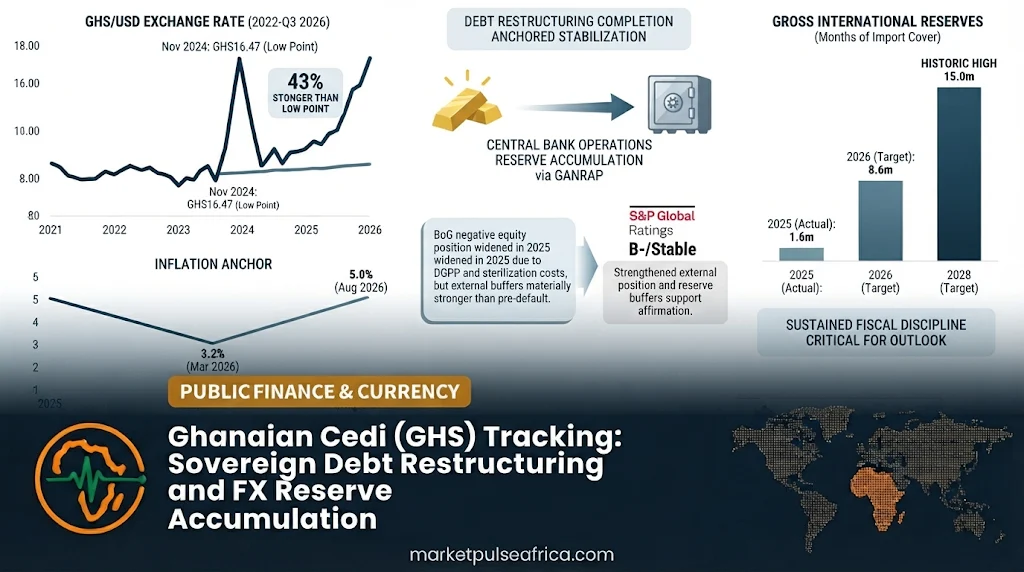
Ghana is the case investors cite as proof that the process can end. Press reports say Ghana prepaid US$700 million of Eurobond debt on 6 July 2026, which was read as a signal about market access. Those reports also cite an IMF staff statement from May 2026 on a legislated debt anchor of 45% of GDP by 2034. Our coverage of the Ghanaian cedi and reserve accumulation looks at the currency side of the same recovery.
Zambia's restructuring is also near full completion. The GSDR report said the remaining negotiation covers a small group of non-bonded commercial creditors, and Zambia completed the sixth and final review of its IMF-supported programme.
The Senegal test
Senegal announced that it would seek debt restructuring under the Common Framework alongside a staff-level agreement with the IMF on a proposed US$2.2 billion lending programme. The GSDR report in October confirmed that Senegal has requested debt treatment under the framework.
Two features make the case different. The government has said it will exclude ordinary CFA franc debt, largely held across WAEMU, from the restructuring, and, unlike Zambia, Ghana and Ethiopia, Senegal is still paying its bondholders. A restructuring of external debt only, while regional debt keeps paying, tests whether the framework can work inside a currency union. Our explainer on the XAF/XOF parity mechanism covers why that matters for the peg.
What it means for investors
- Budget for a long process. A two-year case is the best outcome so far, and a six-year case is possible.
- Read the comparability clause. Official creditors can reject a private deal that looks too generous, as in Ethiopia's January agreement.
- Separate the debt classes. Senegal's exclusion of CFA franc debt means holders of regional paper and holders of Eurobonds face different outcomes.
- Watch market access. A country's return to the Eurobond market after restructuring is a better signal than the completion announcement.
Related Reading
- Read our full coverage of the Ghanaian cedi and reserve accumulation
- Read our full coverage of the XAF/XOF parity mechanism and reserve structure
- Read our full coverage of Cameroonian corporate debt and DSX liquidity
Can Senegal restructure part of its debt without unsettling the rest of the CFA zone? Keep following Market Pulse Africa as the Senegal talks develop.