Ghana's Richest Woman Is Building a Cocoa Empire
Patricia Poku-Diaby built a $90 million cocoa processing plant in Ghana, capturing value multinationals have long controlled
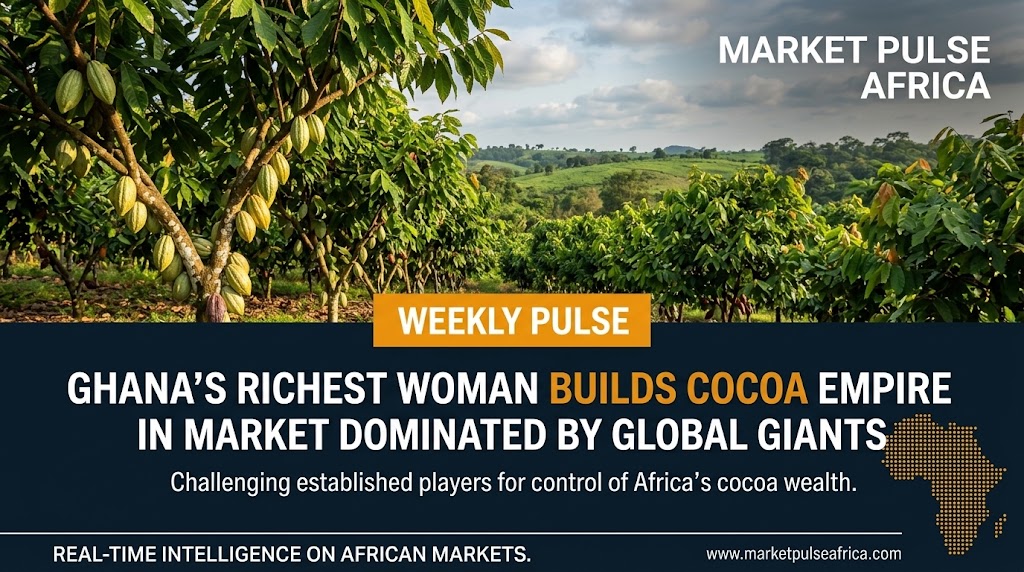
Ghana's Richest Woman Is Building a Cocoa Empire in a Market Dominated by Global Giants
Every morning in Takoradi, Ghana's bustling port city, trucks loaded with cocoa beans roll through the gates of a sprawling processing facility before dawn. To most passersby, it's just another factory. To Patricia Poku-Diaby, it's proof of a bigger idea: that Africa doesn't have to remain the world's raw-material warehouse.
Poku-Diaby, widely known as Ghana's "Cocoa Queen," has built one of the continent's few large-scale, African-owned cocoa processing operations — competing directly with multinational commodity giants in an industry that has historically kept African producers at the bottom of the value chain.
What She Built
Poku-Diaby founded Plot Enterprise Group in 2010, establishing operations first in Côte d'Ivoire before expanding into Ghana. Rather than sticking to commodity trading — buying and reselling raw beans, the path most traders take — she chose the harder route: processing. The centerpiece of that bet is a cocoa processing facility in Takoradi with an annual bean-input capacity of 32,000 metric tonnes, valued at approximately $90 million, making it one of the largest indigenous cocoa-processing investments in Ghana's history. She also operates a 16,000-metric-tonne grinding plant in Abidjan, Côte d'Ivoire.
Today, Plot Enterprise Group employs more than 600 staff and generates revenues reported in excess of $50 million, with commercial relationships spanning West Africa, Europe, the United States, Asia, Australia and the Middle East. Estimates of Poku-Diaby's personal net worth vary by source, ranging from roughly $400 million to $720 million — but by most rankings, she is Ghana's wealthiest woman and the only African woman known to have built a large-scale cocoa processing operation of this scale, in an industry long dominated by multinational corporations and male-led enterprises.
From Family Trading Business to Industrial Champion
Poku-Diaby's path into cocoa processing began far from a factory floor. Born into a family of 18 children, she grew up in Abidjan, Côte d'Ivoire, working in her father's transport and trading company — learning firsthand how goods crossed borders, how supply chains functioned, and where value was created or lost along the way. Those early lessons shaped her eventual strategy: rather than simply moving raw commodities, as her family's business had done, she built the infrastructure to transform them.
The Problem Her Business Addresses
Poku-Diaby's story sits at the center of a structural imbalance that has defined African commodity exports for decades. West Africa produces roughly 70% of the world's cocoa, with Ghana and Côte d'Ivoire accounting for the bulk of global supply — yet most of the value generated downstream, in chocolate, confectionery, cosmetics, beverages and other cocoa-based consumer products, has historically accrued elsewhere. The beans leave African shores; the profits, more often than not, do not.
This pattern repeats across other African commodities: raw cashew leaves West Africa and returns as higher-priced processed nuts; raw cotton is exported while finished garments are imported. Development economists have long argued that the issue for African economies is not production capacity — the continent already produces vast quantities of raw material — but transformation: the ability to process, manufacture, brand and distribute before goods leave the continent.
Why It Matters for Africa
Poku-Diaby's business model illustrates a theme increasingly central to African economic policy discussions — value addition and industrialisation — with direct implications for the countries involved:
Export earnings and value capture. By processing cocoa domestically rather than exporting raw beans, operations like Plot Enterprise capture a larger share of the value chain within Ghana's economy, rather than ceding that value to processors based elsewhere.
Job creation and industrial capacity. A single large-scale processing facility employing 600+ staff represents meaningful formal-sector employment in a country where much of the cocoa value chain historically ended at the point of export.
A template for other African commodities. Similar value-addition efforts are emerging elsewhere on the continent — pineapple processors in Ghana converting fruit into juices and concentrates, cashew processors in Côte d'Ivoire moving into kernel production, and textile manufacturers in Ethiopia working to capture more value from raw cotton — suggesting a broader continental shift toward processing before export.
Proof of concept for private-sector-led industrialisation. Poku-Diaby's success challenges the notion that value addition is primarily a government policy outcome; it demonstrates that African-owned firms can build and finance globally competitive processing infrastructure, provided capital, technology and market access align.
Key Figures at a Glance
Metric | Figure |
|---|---|
Plot Enterprise founded | 2010 |
Takoradi plant capacity | 32,000 metric tonnes/year |
Takoradi plant value | ~$90 million |
Abidjan grinding plant capacity | 16,000 metric tonnes/year |
Employees | 600+ |
Reported annual revenue | $50 million+ |
Estimated net worth | $400 million–$720 million |
West Africa's share of global cocoa supply | ~70% |
What Investors and Businesses Should Watch
Continued expansion of African-owned processing capacity across cocoa, cashew, cotton and other key export commodities, as a signal of the pace of continental value-chain shift.
Access-to-finance developments for large-scale industrial processing investments, given the significant capital requirements Poku-Diaby's own trajectory illustrates.
Government policy on local content and processing incentives in major cocoa-producing countries like Ghana and Côte d'Ivoire, which could accelerate or slow similar investments.
Global cocoa price trends and demand from chocolate and confectionery manufacturers, which directly affect the economics of processing operations like Plot Enterprise.
Key Takeaways
For Businesses
Consider opportunities in downstream processing and value addition within commodity sectors where Africa currently exports mostly raw material.
Monitor financing and infrastructure requirements needed to move from trading into processing, given the significant capital barriers involved.
For Investors
Track African-owned processing and manufacturing ventures as a distinct investment theme from traditional commodity trading exposure.
Watch policy signals on local content requirements in cocoa-producing countries, which could shape the investment case for processing infrastructure.
For General Readers
Understand that Africa's commodity export challenge is generally about transformation capacity, not production volume.
Follow how entrepreneurs like Poku-Diaby are reshaping the economics of industries long dominated by multinational corporations.
How MarketPulse Africa Helps
For readers tracking Africa's shift toward value-added commodity production, MarketPulse Africa's Commodities coverage brings together cocoa market developments, processing sector investment, and the broader industrialisation story shaping African economies. MarketPulse Africa will continue following how entrepreneurs and policymakers are working to keep more value on the continent.
Conclusion
Patricia Poku-Diaby's cocoa empire is more than a personal wealth story — it's a case study in what happens when African entrepreneurs choose to process rather than simply export what the continent produces. With West Africa still supplying roughly 70% of the world's cocoa while capturing only a fraction of the industry's downstream value, her model offers a working template for how African-owned businesses can compete in sectors long dominated by global giants. Follow MarketPulse Africa for continued coverage and real-time intelligence on African markets.