Rivers State has not taken any loans, says RIRS chairman
Rivers State's revenue chief says the current administration has taken no loans. Debt records and the governor's own acknowledgment of a N200 billion ring road loan point to a more complicated picture.
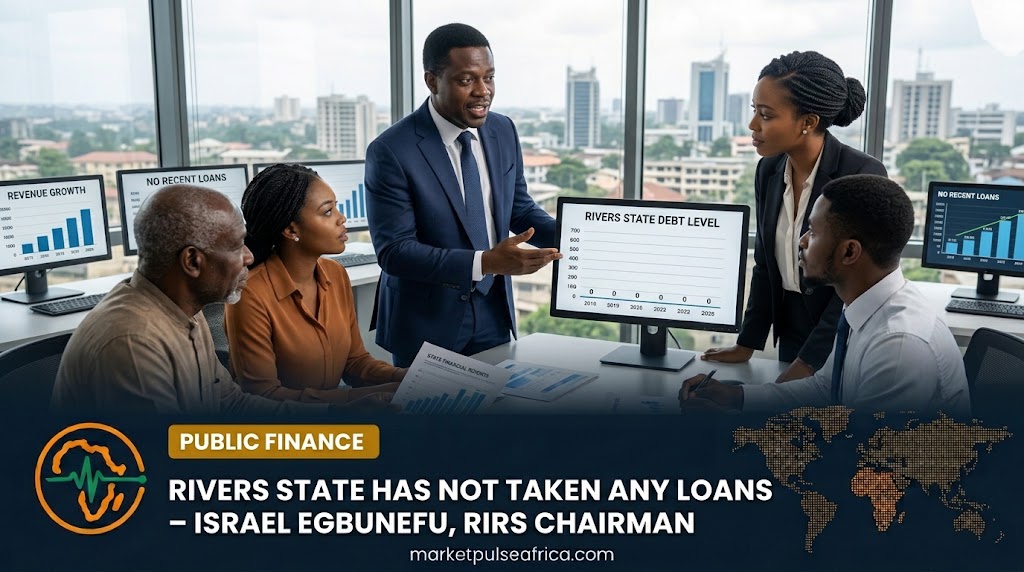
The Executive Chairman of the Rivers State Internal Revenue Service, Israel Egbunefu, has said that the current state administration has not taken any loans. Official debt records and the governor's own statements point to a more complicated picture. The Debt Management Office reported domestic debt of N362.43 billion for Rivers State as of March 31, 2026, and the state's debt stock rose sharply in the years after the 2023 elections. Governor Siminalayi Fubara has said his administration has not borrowed to fund governance, but has acknowledged a N200 billion loan for the Rivers ring road project. The distinction between borrowing for projects and borrowing to fund governance, and between the current administration and earlier ones, is central to the dispute. This article sets out what was said, what the records show, and what remains unclear.
Contents
- What the revenue chief said
- What the debt records show
- The governor's position
- Where the claims do not match
- What to check
What the revenue chief said
In an interview with BusinessDay in Port Harcourt, Egbunefu was asked why Rivers State has not been borrowing for projects like other states. He replied that "this current administration has not taken any loans." He also said that greater tax compliance would reduce the need for the state to borrow. The interview was framed around the Rivers State Internal Revenue Service's work to widen the tax base and deepen revenue generation.
The statement is specific. It refers to the current administration, not to the state's debt history as a whole. That scope matters, because Rivers has carried debt for years, and several records show it rising during the current term.
What the debt records show
The Debt Management Office's first-quarter 2026 report puts Rivers State's domestic debt at N362.43 billion as of March 31, 2026, a decline of about 4 percent from N378 billion in the previous quarter. Nairametrics reported that Rivers was one of the three states that together account for more than 43 percent of the N4.52 trillion in subnational domestic debt across Nigeria's 36 states and the Federal Capital Territory.
Earlier figures show a steeper rise. Nairametrics reported in July 2025 that Rivers' domestic debt rose 56.68 percent, from N232.58 billion to N364.39 billion, in a period it linked to large capital projects after the 2023 elections. The DMO's figures are published with a lag, and the reporting date for each figure should be checked before drawing conclusions about any given year.
Foreign loans are reported separately. Rivers' 2026 budget proposal, presented to the Assembly, includes provisions for domestic and foreign loan interest and for repayment of long-term loans, which indicates that the state is servicing debt.
The governor's position
Fubara has denied that his administration has borrowed to fund governance. Channels Television reported that he said his administration had not been borrowing to fund governance and challenged anyone to verify his position with the DMO. BusinessDay reported that he dismissed claims that the state's external debts had risen from $80 million in 2023 to $203 million in June 2024, and said that the claims should be checked against loans he had signed.
The governor has also acknowledged borrowing for specific capital work. TheCable reported that he said his administration secured a N200 billion loan solely for the ring road project connecting six local government areas. That acknowledgment does not fit with a flat statement that the current administration has taken no loans, unless the revenue chief's comment is read narrowly as referring to governance spending rather than project finance.
Where the claims do not match
The sharpest tension is between the revenue chief's statement and the governor's own acknowledgment. If the N200 billion ring road loan was taken by the current administration, then the statement that the administration has taken no loans cannot be right as written. The governor's denial, by contrast, is narrower: it concerns borrowing to fund governance, not every loan.
The DMO figures add a second layer. They do not show what each loan was used for, or when each was taken, so they cannot settle whether the rise in debt came from the current administration or from earlier periods. Sources have also suggested that some external loans were taken by a previous governor and reported late to the DMO. Those claims are contested and have not been independently verified in the reporting reviewed here.
What to check
Readers should check three things. First, the loan agreements themselves: the amount, lender, date, and the administration that signed each one. Second, the DMO's state-level data for each reporting quarter, along with its notes on when each state's figures were received. Third, the state's audited accounts and budget performance reports, which show how borrowed money was spent.
For investors and businesses, the question is less about the headline claim than about how the state services its debt, and whether revenue growth keeps pace with repayments. A state can borrow responsibly for infrastructure, but the balance between borrowing and revenue determines how much room it has for future projects.